

Medical Evacuation
Save thousands on repatriation costs by investing in a travel membership plan like Emergency Assistance Plus® (EA+®) for protection in an emergency.

Bryanna Moore, Senior Product Manager
·Published on October 29th, 2025
If you pass away while abroad, your loved ones will be left with the challenge of covering repatriation costs. This expense can reach tens of thousands of dollars, so preparing beforehand is essential for financial readiness.
According to recent travel insurance statistics, nearly 1 in 5 U.S. travelers lose money by opting out of travel protection, leaving families unprepared if an emergency happens. Emergency Assistance Plus® (EA+®) provides body repatriation services and facilitates logistics so your loved ones are protected.
This robust guide breaks down repatriation logistics from start to finish. Then, discover travel memberships and insurance programs that reduce costs and give your loved ones lasting peace of mind.
Repatriation costs range from $5,000 to $25,000, primarily depending on where the death occurs and transportation availability within the region. Generally speaking, the deceased’s estate or family is in charge of handling repatriation costs.
Repatriation protection is available through travel membership programs like EA+ to handle logistics and expenses upfront. Travel insurance can also help with expenses, but it typically reimburses funds after claims are processed and approved.
| Expense type | Estimated cost | Notes |
| Air transport / flight | $3,000-$20,000+ | Cremated remains can be flown home for as little as $300 |
| Embalming / preparation | $500-$1,200+ | Specialized shipping containers may add to the overall cost |
| Documentation and permits | $100-$1,000+ | Includes consular permits, death certificates, translation support, and any additional paperwork |
| Funeral home services | $1,000-$3,000+ | Local coordination and preparation upon the deceased’s arrival home |
| Optional costs | $500-$5,000+ | Ceremonial fees, additional family travel, storage fees |
| Total estimated cost | $5,000-$25,000+ | Costs depend on transportation distances and the complexity of services needed |
The cost of your repatriation varies from case to case, but a handful of factors determine the overall amount you need to pay out of pocket. The distance of travel and the complexity of flight arrangements play the largest role in pricing.
Other elements that affect cost are local regulations, the complexity of documentation, or family members traveling alongside the remains.
The location of the death can greatly affect the cost and complexity of repatriation, which can take several days or weeks to complete.
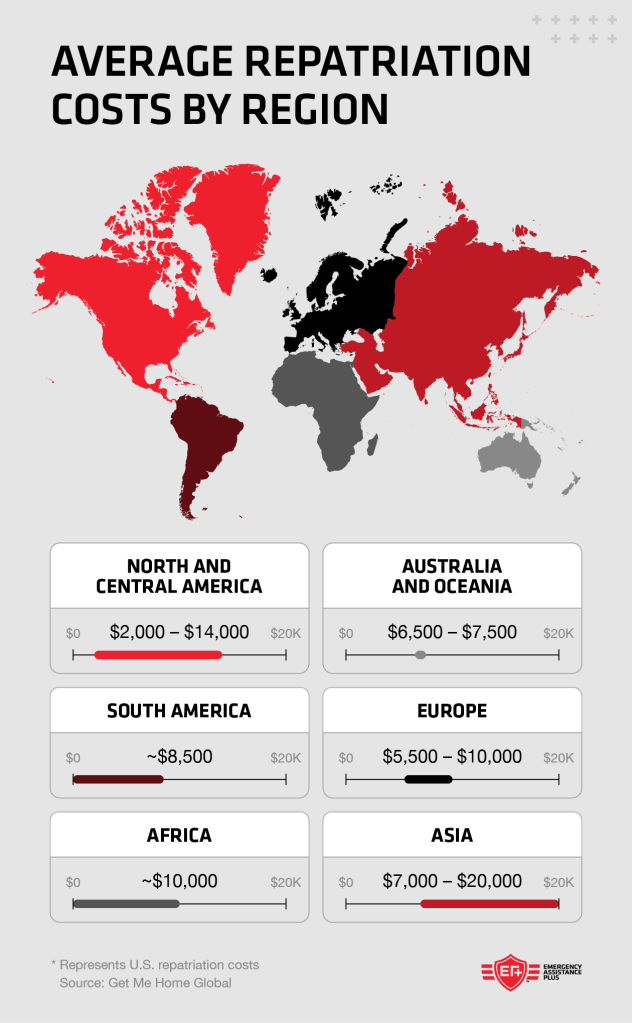
For example, transporting remains from Canada to the U.S. is a much shorter distance than a return from Europe. Consequently, it’s usually less expensive and resolved quickly. Some locations are harder to access, which affects the price and timeline if multiple forms of transportation are needed.
Specific containers are sometimes required for the body repatriation process and vary from location to location. For instance, Italy requires that your remains are sealed in a hermetically closed or zinc-lined casket during air transport to meet local compliance requirements.
While some relocations only necessitate a quick flight, others require additional ground transportation, especially in remote areas where an airport isn’t nearby. Rates for air travel cost between $3,000 and $20,000. There may be an additional transportation fee if a loved one travels with the remains.
The final transportation cost is determined by the overall distance, type of aircraft, and weight of remains.
The remains may need embalming to cross country borders, depending on the starting destination. The cost of this service can range from $500 to $1,200, depending on local regulations.
Since human remains need to be securely shipped, a funeral home may require an additional purchase of a specialized container or casket to comply with customs regulations.
Repatriation comes with a significant amount of paperwork. Expect to apply for death certificates, transportation permits, and embalming reports, and pay administrative and legal fees with the local consulate.
Even one mistake can make the process more expensive and cause delays, so enlisting a travel assistance program like EA+ may be best for those seeking support with logistics.
Funeral homes are a crucial thread between the location of the deceased and a family’s home region. An associate can handle and store the body, handle local transportation, and connect with embassies or consulates on your behalf.
Pricing typically ranges from $1,000 to $3,000. The exact cost depends on how much responsibility the funeral director takes on and the complexity of the process.
There are four primary ways to cover repatriation costs, and some can be combined for more comprehensive support. Make sure to invest in options with clear repatriation terms, transparent pricing, and a supportive customer support team.
Travel assistance memberships offer travelers hands-on support when an emergency occurs, arranging logistics, medical evacuations, and repatriations to a home country when needed.
Unlike traditional travel insurance, membership programs like Emergency Assistance Plus take care of eligible costs upfront, giving you peace of mind by eliminating unexpected bills.
Travel insurance can cover trip cancellations, lost luggage, flight delays, and medical emergencies, depending on the depth of your specific plan. More comprehensive plans may also offer travel insurance with repatriation coverage. However, the repatriation insurance cost may not be fully reimbursed.
Certain providers only cover transportation, while others may extend protection to containers and embalming services. Travel insurance companies may also offer accident protection, which consists of a lump-sum payout in the event that a traveler passes away during a covered trip.
Many credit cards come with additional travel benefits, including travel accident compensation. For example, the Chase Sapphire Reserve card offers up to $1 million in travel insurance coverage for an accidental death.
Funds can ultimately be applied to repatriation costs. Bank of America covers up to $1,000 for the repatriation of remains for eligible cardholders.
These benefits are usually available on mid- and top-tier credit cards, which often come with hefty annual fees, so make sure to factor that into your budget and book your trip directly on the card to ensure your trip is eligible for protection.
Check your employer’s benefits package to see if you receive life insurance or a death benefit credit. This credit can reimburse a variety of expenses, depending on your employer.
While these repatriation services can be a great value when bundled into your other benefits, they’re usually only active during your employment with the providing company.
The repatriation process begins with a few important calls. Here’s what to do:
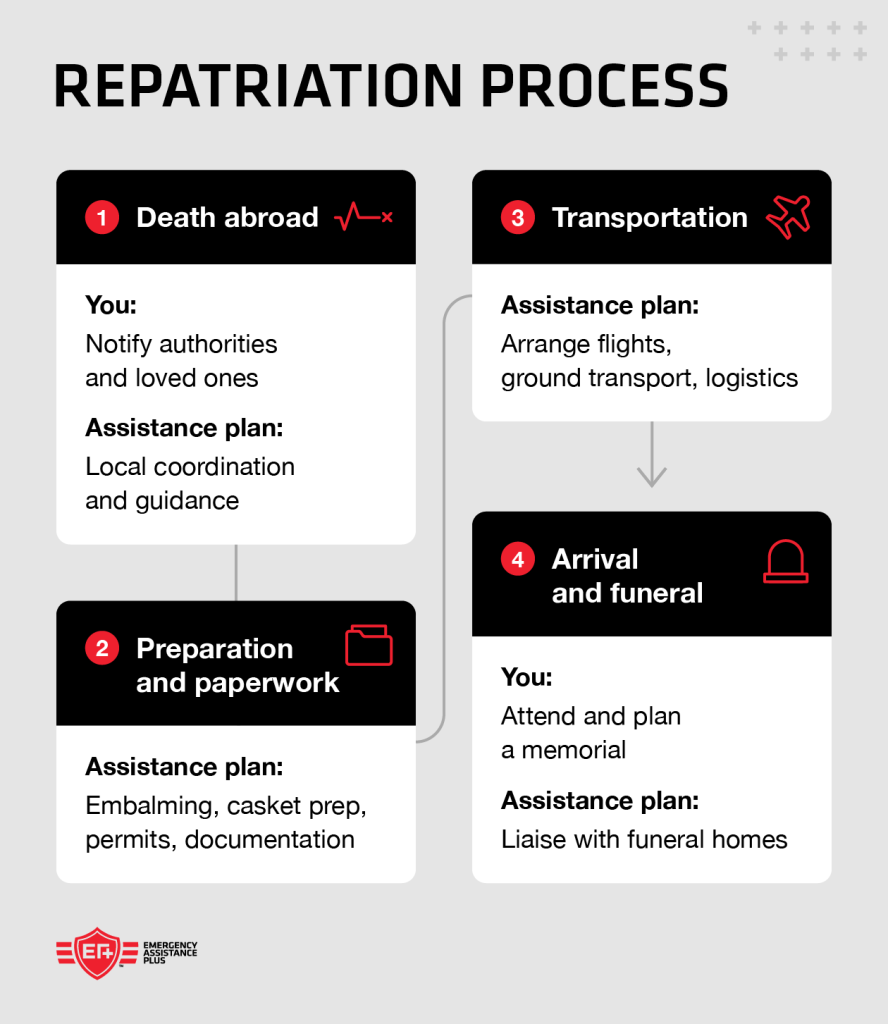
The process may feel complex for loved ones grieving a loss. EA+ offers “return of remains” support, pairing you with an experienced travel expert who can handle paperwork, travel arrangements, and funeral home logistics.
Having a clear understanding of repatriation costs in the event that you or a loved one passes away abroad makes the process more manageable and reduces the burden with professional travel support.
To avoid a costly emergency, take time to research various protection options to find one that best suits your travel needs. With the right fit, you can save hours of time and thousands of dollars if anything happens.
Emergency Assistance Plus’ membership plan protects travelers worldwide, offering plans that protect both individuals and families while abroad. Your membership includes domestic and international emergencies for an entire year, so you won’t have to worry about purchasing a plan for every individual trip.
Enroll nowRepatriating a body home from an international destination costs between $5,000 and $25,000. The exact amount depends on the distance the deceased needs to travel and the origin country.
Travel insurance and travel membership programs can reduce the cost of the repatriation when purchased in advance.
Some travel insurance companies offer repatriation protection as a benefit, but there may be limits to the total reimbursement amount. Additionally, covered services may be limited. For example, a travel insurance plan may cover transportation but may not cover other related expenses.
Repatriation may be included in travel membership programs. For example, EA+ has a built-in “return of remains” service included in the essential membership, which costs $229 per year.
Membership programs offer repatriation support, transportation, and logistical planning, which isn’t always included in a traditional travel insurance plan.
Repatriation can take anywhere from seven days to two weeks, though the process typically takes between three and 10 days. The length of time depends on how quickly documents are prepared and the distance between the travel location and the home destination.
An international repatriation flight costs between $3,000 and $20,000 and depends on the weight of the deceased, the weight of the casket, the type of aircraft, the specific airline, and the distance of the route. Domestic repatriation flights cost less, ranging from $1,500 to $5,000.
Repatriation is the process of sending a person’s remains home after they’ve passed away while traveling. Medical repatriation is a service for living travelers who experience an emergency abroad and need transport to the nearest sufficient medical facility.
Long-distance medical transport costs tend to be lower than traditional repatriation costs because it doesn’t require the same specialized logistical and legal requirements as international repatriation.
Bryanna has been with Emergency Assistance Plus (EA+) for nearly 20 years, starting in customer service and now, as Senior Product Manager, she is responsible for member experience – including ensuring that the services EA+ provides continues to meet the evolving needs of EA+ members. Bryanna is passionate about EA+ members and making sure that Emergency Assistance Plus delivers on its brand promise to get members home safely in their time of need.


Medical Evacuation · January 30, 2026

Medical Evacuation · January 29, 2026

Medical Evacuation · January 29, 2026
![What Is the Average Air Ambulance Cost and How To Prepare [2026]](https://eap.agiatest.dev/wp-content/uploads/2025/03/air-ambulance-cost-hero.jpg?w=350&h=185&crop=1)
Medical Evacuation · January 29, 2026

Medical Evacuation · January 29, 2026

Medical Evacuation · April 29, 2025
